Breaking new grounds in understanding forest water stress
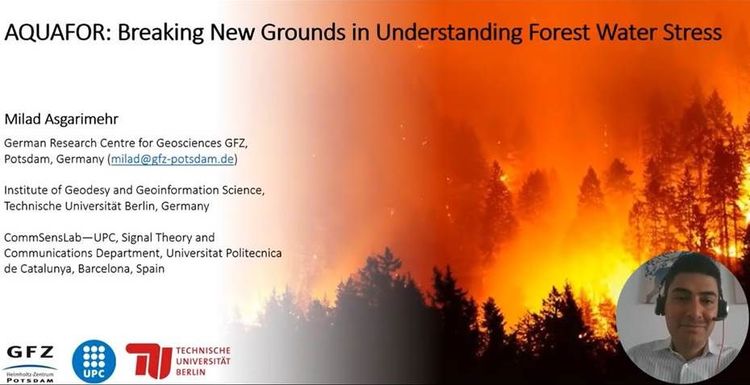
As part of the Scientists for Nature Class of 2024, Dr Milad Asgarimehr presented his pioneering work on AQUAFOR, a transformative initiative that is redefining how the world understands and responds to forest water stress. Climate change is driving rising temperatures, erratic rainfall, and prolonged droughts, placing forests under unprecedented pressure and heightening the risks of wildfires, biodiversity loss, and large-scale ecosystem instability. Dr Asgarimehr’s research directly targets this global challenge, addressing limitations in how water stress is currently monitored and understood.
Forests experiencing water stress undergo physiological changes that weaken their ability to support plant and animal life, accelerating habitat degradation and undermining the essential ecosystem services - clean air, clean water, and climate regulation - upon which all species depend. Yet today’s monitoring systems rely heavily on localised measurements and low-frequency satellite observations, making it nearly impossible to assess diurnal moisture dynamics or map stress patterns on a global scale. These gaps hinder conservation efforts and limit our ability to respond effectively to climate-driven threats.
Dr Asgarimehr’s AQUAFOR project introduces a groundbreaking solution: the integration of Global Navigation Satellite Systems Reflectometry (GNSS-R) with advanced deep learning models to monitor global vegetation water content with unprecedented precision. GNSS-R makes use of signals from more than 32 GPS satellites, originally designed for navigation but exceptionally powerful when repurposed to analyse reflections off forested landscapes. By harnessing this unique data stream, AQUAFOR enables high-resolution, diurnally informed tracking of forest water stress at ecosystem scales.
The project goes beyond observation. With a state-of-the-art deep learning framework, AQUAFOR aims to predict global forest water stress under diverse environmental conditions, including future climate change scenarios. These predictive capabilities are poised to reshape conservation strategies by providing early warnings, enhancing resilience planning, and guiding adaptive ecosystem management. Over time, AQUAFOR could become a cornerstone technology for safeguarding global biodiversity and mitigating climate risks.
Dr Asgarimehr’s vision reflects a future where cutting-edge satellite science and machine learning safeguard the planet’s forests, enhance ecological resilience, and provide humanity with powerful tools to confront climate-driven environmental degradation.
His presentation at Scientists for Nature in Lindau 2025 can be viewed in the video below.
Video content
This video is hosted by a third-party service that may set cookies. Accept cookies to view the video.