Refreeze the Arctic
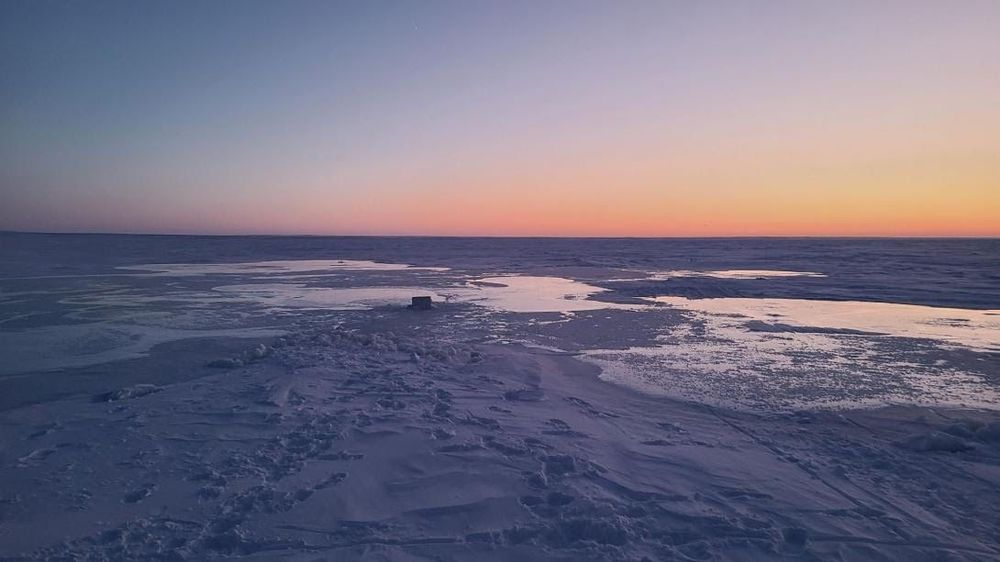
We are pleased to contribute to the cutting-edge research by Dr Shaun Fitzgerald and PhD candidates Jacob Pantling and Jacob Cook at the Centre for Climate Repair at the University of Cambridge, which aims to safeguard the future of the Arctic and help stabilise the global climate by restoring and preserving sea ice.
Why arctic sea ice matters
Arctic sea ice acts as a critical ‘global cooling shield’: its reflective surface sends much of the sun’s energy back into space. As Arctic ice disappears, dark ocean water absorbs more sunlight instead of reflecting it, thus accelerating warming with severe consequences for climate, weather patterns, sea levels, and polar ecosystems. With summer sea-ice shrinking dramatically in recent decades, and scientists warning of potential future seasons with almost no ice, protecting and rebuilding Arctic sea ice has become one of the most urgent climate goals.
Cambridge's 'sea-ice thickening' research – ambitious and science-driven
At Cambridge University, researchers are investigating two promising techniques to strengthen and renew Arctic ice during winter:
- Surface thickening (led by PhD candidate Jacob Pantling): pumping seawater onto existing ice when there is no snow cover. In the cold Arctic winter air, this water freezes quickly, adding new ice on top.
- Snow flooding (led by PhD candidate Jacob Cook): flooding the insulating snow layer with seawater so that it consolidates into solid ice. Solid ice is far less insulating than loose snow, which allows more natural freezing beneath, helping the ice grow from below.
These techniques are being tested through modelling, lab-based experiments (in cold-room settings), and small-scale field trials - to learn how much extra ice can realistically be generated, and how the ice behaves over time.
In 2025 the project entered a key phase: controlled, small-scale winter field experiments in Arctic regions, running over several seasons (2025–26 to 2027–28), to evaluate the effectiveness, feasibility, and ecological safety of sea-ice thickening.
The Families for Nature Foundation has committed funding for both PhD candidates thus enabling the Centre for Climate Repair to carry out these essential research projects as part of Refreeze the Arctic. Our funding is helping to build long-term capacity and enabling rigorous, science-based exploration of what might be one of the most ambitious climate-intervention projects to date.
If the approach scales, preserving or rebuilding Arctic ice could:
- Slow global warming by maintaining Earth’s natural ‘cooling mirror’, reducing heat absorption by dark ocean water.
- Buy time to accelerate broader existing decarbonisation and nature-restoration efforts - giving the world a stronger chance to meet climate targets while reducing transition risks.
- Help protect polar ecosystems, local Arctic communities, and the cultural heritage of Indigenous and northern populations whose lives depend on stable ice cover.
- Provide a model for combining engineering, science, community involvement and global coordination — showing that bold, systemic climate solutions are possible.
We believe the University of Cambridge’s research embodies the kind of bold, scientifically grounded, long-term thinking that is needed for the climate crisis. By supporting this work, we aim to contribute to a future where we don’t just slow damage - but actively restore critical planetary systems.
On the ice: live from our Arctic research | Centre for Climate Repair
Can We Refreeze the Arctic’s Ice? Scientists Test New Geoengineering Solutions | Scientific American
Video content
This video is hosted by a third-party service that may set cookies. Accept cookies to view the video.